

Luxury Modern Kitchen Ideas: A Guide to Contemporary Bespoke Design
What does 'modern' really mean in luxury kitchen design? From handleless cabinetry and engineered stone to invisible technology and the art of restraint, we explore the principles behind truly contemporary bespoke kitchens.
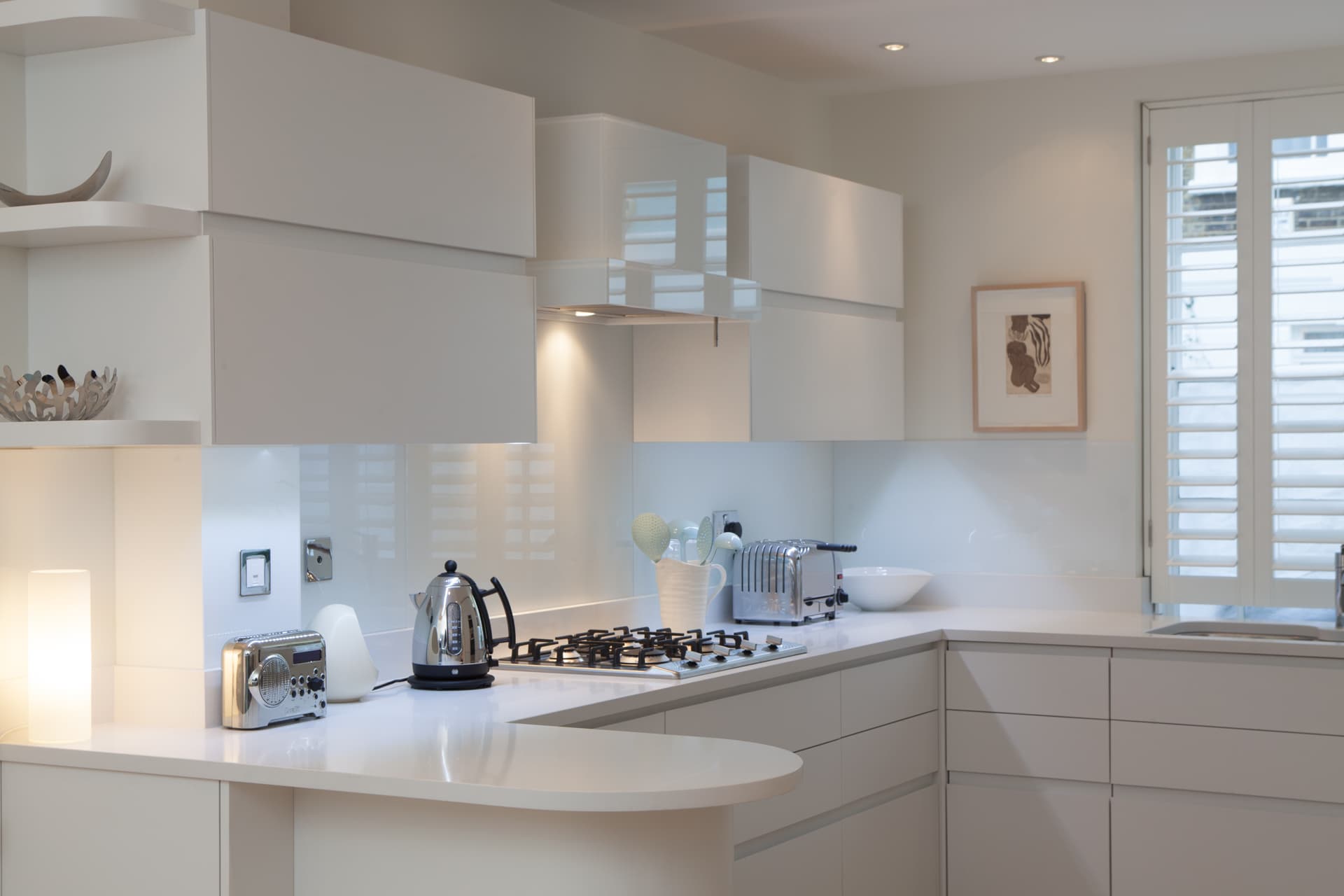
There is a peculiar misunderstanding at the heart of most conversations about modern kitchens. Say the word "modern" and people immediately picture handleless slab doors in high-gloss white, a waterfall-edge island, and some strategically placed LED strip lighting. It is a look. But it is not really what modern means — at least, not in the context of luxury kitchen design.
A truly modern luxury kitchen is not defined by a particular door style or finish. It is defined by a philosophy: that every element should earn its place, that complexity should be hidden rather than displayed, and that the room should feel effortlessly calm even when it is working extraordinarily hard. It is architecture as much as cabinetry. And when it is done well, it is one of the most satisfying spaces a home can contain.
What follows is a thorough exploration of what contemporary design means at the luxury end of the market — the principles, the materials, the debates, and the details that separate a genuinely modern bespoke kitchen from one that merely looks the part.
What "Modern" Actually Means in Luxury Kitchen Design
Let us be clear about something. Modern, in the context of a luxury kitchen, does not mean minimalist for the sake of it. It does not mean cold. It certainly does not mean sacrificing comfort or warmth on the altar of clean lines.
What it does mean is intentionality. A modern luxury kitchen is one where every surface, every junction, every mechanism has been considered and resolved. The doors close with a weighted precision. The drawers glide on concealed runners engineered to carry thirty kilograms without complaint. The lighting shifts from task-bright to ambient at the touch of a panel you barely notice. The extractor rises silently from the worktop and disappears again when supper is done.
This is what distinguishes a luxury modern kitchen from a merely contemporary one. The contemporary kitchen borrows the visual language — flat panels, restrained hardware, neutral tones. The luxury modern kitchen delivers the substance behind that language: the engineering, the material quality, the obsessive attention to how things meet, move, and age.
At Albury House, we think of modern design as a discipline of refinement. Not how much can we add, but how much can we resolve. The best modern kitchens we have made are the ones where clients walk in and feel a sense of calm before they can quite articulate why. That calm is the product of hundreds of small decisions, all made well.
The Principles of Contemporary Luxury
If there is a unifying thread through the luxury modern kitchens we design and build, it is this: the harder the kitchen works, the less it should show the effort. Behind that simple idea sit several organising principles.
Clean Lines, Honestly Achieved
Clean lines are the foundation of modern kitchen design, but there is a world of difference between lines that are clean because they have been designed with precision and lines that are clean because someone has hidden the problems behind a flat panel.
In a bespoke modern kitchen, clean lines begin at the carcass. Every cabinet is built to the exact dimensions of the space, eliminating the fillers and scribing strips that betray standard-module kitchens. Worktops are templated and fitted to walls with hairline accuracy. Where cabinetry meets architecture — a ceiling, a window reveal, a structural beam — the junction is resolved with purpose, not patched with trim.
This is the kind of detail that photographs rarely capture but that you notice every day you live with a kitchen. It is also why bespoke manufacture matters so much in modern design. When there is nowhere for imprecision to hide, imprecision cannot be tolerated.
Hidden Complexity
The luxury modern kitchen is, in many ways, the most technically demanding kitchen to build. A traditional kitchen can charm its way past a minor inconsistency — a decorative moulding, a patina'd surface, a characterful irregularity. A modern kitchen offers no such cover.
Behind those serene flat surfaces, the cabinetry is doing remarkable things. Pocket doors slide silently into recesses to reveal breakfast stations. Corner units deploy shelving on multi-axis mechanisms. Bins sort themselves beneath push-to-open panels. Charging drawers keep devices powered without a cable in sight.
None of this should be visible when the kitchen is at rest. The measure of a well-designed modern kitchen is not how impressive it looks when everything is open and in use. It is how composed it looks when everything is closed.
Seamless Integration
In a traditional kitchen, the cooker is a statement piece. The fridge might be freestanding. The dishwasher hums behind a decor panel, but everyone knows it is there. Modern luxury design takes a different view: every appliance should disappear into the architecture of the room.
This means column refrigeration concealed behind full-height cabinetry panels. Ovens and steam ovens built into tall housings with flush-mounted fronts. Integrated coffee systems that present a single clean facade when not in use. Induction hobs set flush with the worktop surface, their presence betrayed only by discreet zone markings.
The ambition is that a visitor could walk into the room and struggle to identify it as a kitchen at all — until someone begins to cook, and the space reveals itself.
Modern Materials: The Luxury Palette
Material selection is where a luxury modern kitchen announces its seriousness. The palette has expanded enormously in recent years, and the most interesting contemporary kitchens draw from it with confidence.
Engineered Stone and Porcelain
Natural marble will always have its devotees, and rightly so. But the luxury modern kitchen has largely migrated to engineered surfaces — not out of compromise, but out of conviction. Ultra-compact porcelain slabs offer the visual depth of natural stone with none of the maintenance anxiety. They do not stain, they do not etch, and they can be specified in thicknesses as slim as six millimetres for a daringly fine worktop edge.
Engineered quartz remains popular for its consistency and durability, whilst Dekton and Neolith have opened up possibilities for bookmatched porcelain slabs that mimic the veining of Calacatta marble with startling fidelity — and rather better resistance to a squeeze of lemon.
For the island top in particular, a material that can handle daily life without fuss is not a concession. It is intelligent design.
Brushed and Blackened Metals
Metal plays a defining role in the modern luxury kitchen, but not the polished chrome of a decade ago. Today's palette favours brushed stainless steel, blackened brass, bronzed nickel, and gunmetal — surfaces with texture and depth that catch the light differently as you move through the room.
Metal appears in plinths, in open shelving frames, in slim island legs, and in the edge profiles of handleless cabinetry. A blackened steel shelf bracket in an otherwise all-timber kitchen can be the single detail that tips the design from traditional into contemporary. Used sparingly, metal is the punctuation of modern kitchen design.
Matte Lacquer and Painted Finishes
Gloss has had its moment. The modern luxury kitchen overwhelmingly favours matte and ultra-matte finishes — and for good reason. Matte lacquer absorbs light rather than reflecting it, creating surfaces that feel deeper and more substantial. Fingerprints are less visible. The overall impression is one of quiet confidence rather than high-shine declaration.
At the deeper end of the spectrum, we are seeing strong interest in colours like midnight blue, forest green, charcoal, and warm clay — tones that bring richness without weight. Paired with lighter oak internals or a pale stone worktop, a dark matte lacquer creates the kind of contrast that makes a room feel both modern and welcoming.
Smoked Glass and Fluted Timber
For those seeking texture within a modern framework, smoked glass and fluted or reeded timber offer possibilities that are distinctly contemporary without being cold. Smoked glass in wall-mounted cabinets creates depth and obscures contents without hiding them entirely — a useful trick in an open-plan space where the kitchen remains visible from the living area.
Fluted timber panels, whether in oak, walnut, or a painted finish, add a rhythm and tactility that flat surfaces alone cannot provide. We have used fluted panels as island ends, as feature walls behind ranges, and as a unifying detail across tall cabinetry. It is a subtle intervention, but it transforms the feel of a room.
The Handleless vs Minimal-Handle Debate
No discussion of luxury modern kitchens is complete without addressing the question of handles. It is, in our experience, one of the decisions clients think about longest — and understandably so. The handle, or its absence, defines the visual character of the kitchen more than almost any other single element.
True Handleless Design
A true handleless kitchen uses one of several mechanisms to open doors and drawers without visible hardware. The most refined is the integrated channel grip — a recessed groove machined into the top edge of a door or the underside of an overhanging worktop that provides a finger pull without any external profile. The effect is a completely unbroken facade: lines of cabinetry that read as planes of colour and material, nothing more.
Push-to-open mechanisms offer an even purer line, eliminating even the shadow of a grip channel. But they require confidence in the mechanism's reliability — and a household willing to accept that opening a drawer involves pressing rather than pulling.
The handleless kitchen, done well, is undeniably striking. But it carries a responsibility: when there is no hardware to provide visual interest, the quality of the surfaces, the precision of the gaps, and the alignment of the cabinetry must be absolutely faultless. There is, quite literally, nothing else to look at.
Minimal-Handle Design
The alternative — and in our studio, the slightly more popular choice — is a minimal-handle approach. This might mean a slim, flush-mounted edge pull in brushed brass. A recessed tab handle in blackened steel. A slender D-bar in stainless steel that sits so close to the door face it barely registers.
Minimal hardware gives the kitchen a tactile anchor. There is something to grasp, something that tells your hand where to go without you having to think about it. For families with young children, or for anyone who simply prefers the reassurance of a proper handle, this approach delivers a modern aesthetic without the occasional frustration of searching for the grip.
The honest answer is that both approaches work beautifully. The choice is not about which is objectively better, but about which feels right for the way you live. If you would like to see both in person, a visit to our portfolio will give you a sense of how each reads in a finished space.
Open-Plan Considerations for the Modern Kitchen
The luxury modern kitchen is, more often than not, an open-plan kitchen. And open-plan design brings a particular set of challenges that are worth addressing honestly.
The first is noise. A kitchen that opens into a living space must manage the sound of extraction, of running water, of the dishwasher's evening cycle. Modern solutions include downdraft extractors that contain cooking noise and odour at source, ultra-quiet dishwashers rated below 40 decibels, and strategic placement of utility functions — boiling water taps replacing kettles, integrated waste disposal reducing trips to the bin.
The second is visual order. In a closed kitchen, you can leave the aftermath of dinner and shut the door. In an open plan, the kitchen is always on display. This is where the discipline of concealed storage proves its worth. If everything has a home — and that home is behind a closed door or within a purpose-built drawer — the kitchen can return to visual composure in minutes.
The third is zoning. A successful open-plan modern kitchen creates clear psychological zones without physical barriers. The island typically serves as the primary divider, with its seating side facing the living area and its working side facing the hob and sink run. Changes in flooring material, ceiling treatment, or lighting temperature can reinforce this separation without interrupting the flow of the space.
Integrating Technology Invisibly
Technology in the modern kitchen should be felt, not seen. The days of a visible control panel or a tablet stuck to the wall are — mercifully — behind us.
Today's most considered modern kitchens integrate technology at the infrastructure level. Lighting is controlled via pre-programmed scenes that adjust colour temperature and intensity for morning, cooking, entertaining, and late evening. Underfloor heating zones are calibrated so the kitchen floor is warm where you stand to cook and cooler beneath cabinetry where warmth is unnecessary.
Audio is built into the ceiling or concealed within cabinetry, controlled from a phone or voice assistant. Charging drawers with integrated USB-C ports keep devices powered without trailing cables. Some clients opt for motorised shelving that lowers from tall cabinets at the touch of a button, bringing heavy items to a comfortable working height.
The principle is simple: technology should serve the room without demanding attention. The moment you notice the technology, the design has failed.
The Modern Island: Centrepiece and Workhorse
If the modern luxury kitchen has a single defining element, it is the island. And the modern island has evolved far beyond a simple rectangular block with a waterfall end.
Today's luxury kitchen islands are multi-functional monuments to intelligent design. A single island might incorporate an induction hob with integrated extraction, a preparation sink, a run of deep-pan drawers, open display niches, a breakfast bar at a dropped height, and concealed power points — all within a form that reads as a single, composed piece of furniture.
Proportion is critical. An island that is too small feels timid in a generous space; too large and it impedes the room's flow. As a general principle, we allow a minimum of 1,000mm clearance on all working sides and 900mm on passage sides. The island's height, depth, and overhang are all calibrated to the people who will use it — because in a bespoke kitchen, "standard" is not a dimension we recognise.
Material contrast often defines the island's character. A dark-stained oak island base beneath a pale porcelain top. Fluted panels on the dining side, flat panels on the working side. A slim metal plinth that lifts the island off the floor and gives it the presence of a freestanding piece. These are the details that elevate an island from functional to exceptional.
Modern Meets Heritage: Contemporary Kitchens in Period Homes
One of the most rewarding design challenges — and one we encounter frequently along the M11 corridor with its wealth of Georgian, Victorian, and Edwardian homes — is placing a contemporary kitchen within a period property.
The instinct is often to match the kitchen to the house: traditional home, traditional kitchen. But some of the most memorable kitchens we have designed take the opposite approach. A crisp, handleless kitchen in a room with original cornicing and a flagstone floor creates a visual tension that makes both the old and the new more vivid. The architecture gains a foil. The kitchen gains a context.
The key is calibration. A completely unadorned modern kitchen can feel jarring in a heavily detailed Georgian room. But introduce a few considered references — a worktop edge with a subtle chamfer, cabinetry colours drawn from the heritage palette, hardware with a hand-finished quality — and the contemporary design begins to feel like a natural inhabitant rather than an intruder.
We often find that the most successful modern kitchens in older homes retain the room's original floor, its ceiling details, and its window architecture whilst replacing everything at cabinetry level with clean, contemporary design. The contrast between aged stone underfoot and precision matte cabinetry above is quite something.
For more on navigating the balance between old and new, our luxury kitchen design guide explores this in greater depth.
Colour and Finish Trends for Modern Luxury
Colour in the luxury modern kitchen has shifted decisively away from the all-white interiors that dominated for a decade. White remains a valid choice — particularly in smaller or north-facing kitchens — but the more confident conversation is happening in colour.
The Neutrals Have Depth
Warm greiges, mushroom tones, and soft putty shades are replacing cool greys. These colours work beautifully with natural timber and brass accents, and they have the advantage of shifting subtly with changing light — cool and crisp on a bright morning, warm and enveloping in the evening.
Dark Tones Make a Statement
Midnight blue, deep olive, charcoal, and near-black finishes are enormously popular in modern luxury kitchens, particularly on island cabinetry or tall housings where the large, uninterrupted surfaces allow the colour to develop real presence. A dark kitchen is not a gloomy kitchen — paired with the right lighting, warm metals, and lighter countertops, it feels rich, sophisticated, and surprisingly intimate.
Two-Tone Is Here to Stay
The combination of a lighter perimeter with a darker island — or vice versa — has moved from trend to established practice. It works because it reinforces the zoning of the kitchen: the island reads as a distinct piece of furniture within the room, whilst the perimeter cabinetry recedes into the architecture.
We are also seeing interest in three-tone kitchens, where a third finish appears on tall units or a feature wall of cabinetry. Handled with restraint, this layering of colour and finish creates a sense of depth and sophistication that a single-finish kitchen cannot match.
The Return of Timber
Timber, particularly oak, is reasserting itself in modern kitchens — not as the dominant material but as a warm counterpoint to painted or lacquered surfaces. A run of oak open shelving. A timber-clad island end. Drawer interiors in oiled walnut. These elements bring a human warmth to the modern kitchen that prevents it from ever feeling clinical.
Where to Begin
Designing a luxury modern kitchen is an exercise in clarity. It begins not with choosing finishes or layouts, but with understanding how you want the room to feel and how you need it to perform. The rest follows from there.
If you are considering a contemporary bespoke kitchen — whether for a new build, a period renovation, or a complete reimagining of your current space — we would welcome the chance to discuss your ideas. Our design consultation is relaxed, thorough, and entirely without obligation. We will listen before we draw, and we will not suggest modern for its own sake. We will suggest what is right.
For further inspiration, explore our portfolio of completed kitchens, or read our broader guide to bespoke kitchen design ideas for approaches that span the full spectrum from traditional to contemporary.
The best modern kitchens, like the best architecture, do not shout. They simply make you feel that everything is exactly where it ought to be.
Frequently Asked Questions
Thinking about a new kitchen?
Book Your Free ConsultationYou might also enjoy
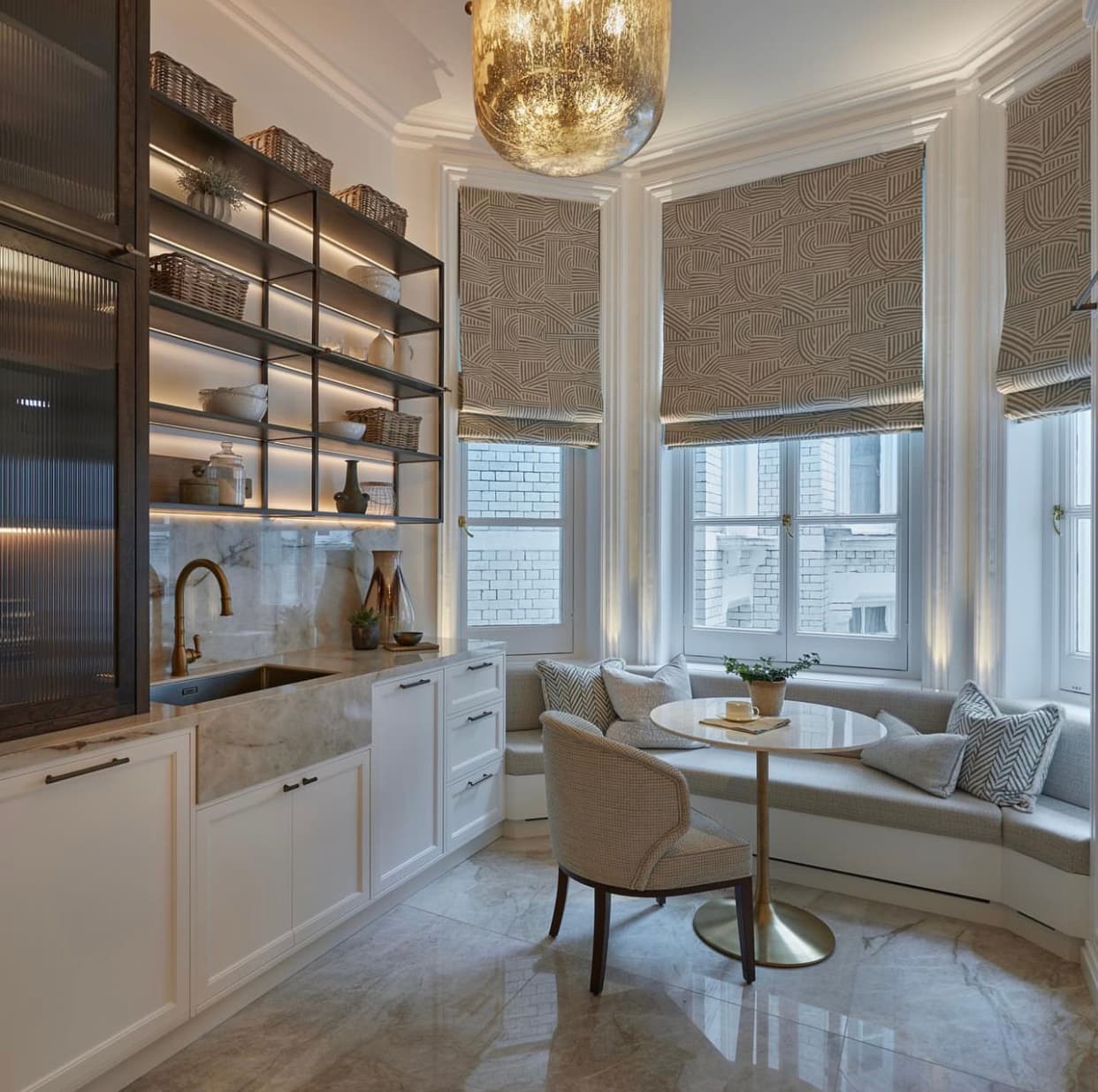
Banquette Seating Kitchen: The Art of Built-In Dining Done Properly
Explore how banquette seating transforms kitchen dining — from L-shaped corners and curved booths to storage-smart benches, upholstery choices, and dimensions that actually work. Inspiration for bespoke kitchens that invite you to sit down and stay.
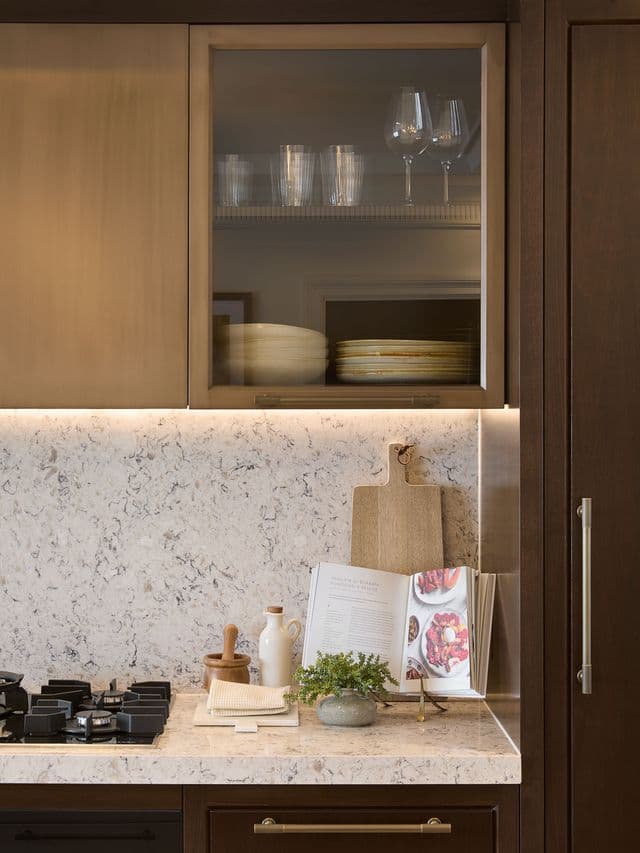
Arts and Crafts Kitchen Design: Where Handcraft Meets the Heart of the Home
Explore how the Arts and Crafts movement inspires truly bespoke kitchen design — from hand-forged ironmongery and English oak to William Morris colour palettes. A guide to creating kitchens that honour the handmade.
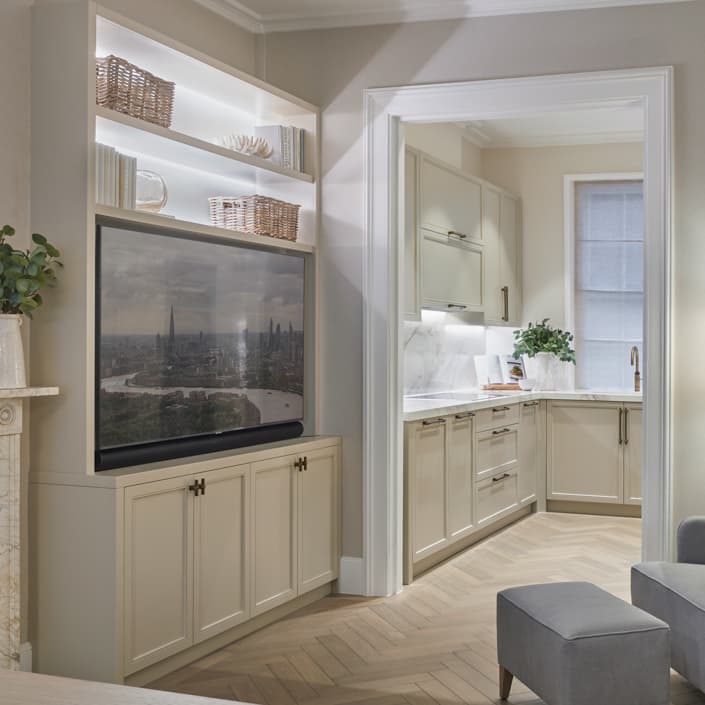
Barn Conversion Kitchen Design: Bespoke Kitchens for Extraordinary Spaces
Designing a kitchen for a barn conversion demands a bespoke approach. From double-height ceilings and exposed trusses to acoustic management and island design, discover how Albury House Kitchens creates luxury kitchens that honour agricultural architecture whilst delivering modern performance.