

Hidden Scullery Design: The Secret Room Transforming Luxury Kitchens
Discover how a hidden scullery design can revolutionise your kitchen — from concealed prep spaces and pocket doors to plumbing layouts and smart storage. A practical guide to the luxury feature redefining how we cook and entertain.
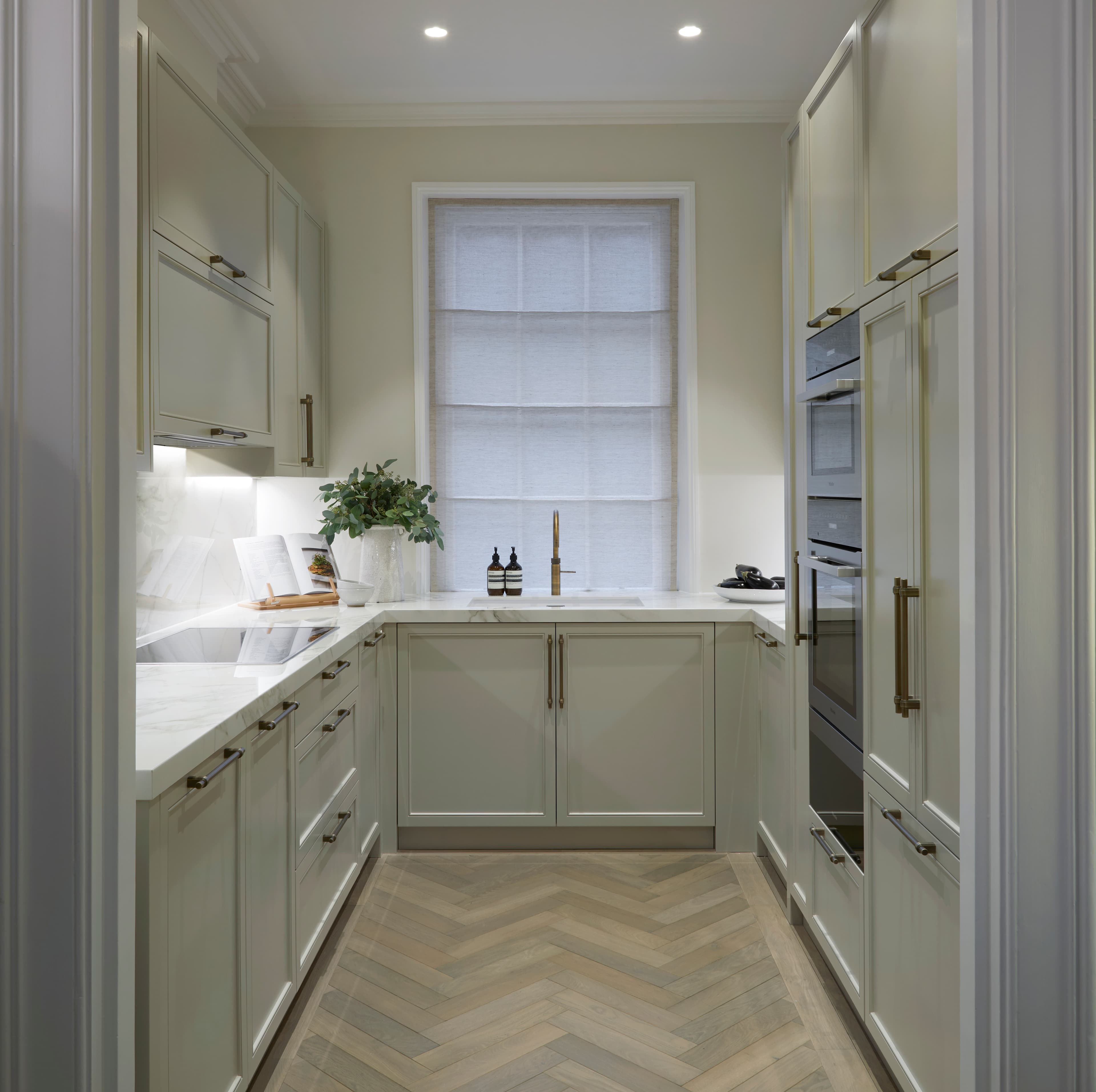
There is a well-worn phrase in kitchen design: the best room in the house. Estate agents trot it out. Magazine editors lean on it. And it is, broadly, true — the kitchen really has become the room where everything happens. Which is precisely why it has a problem.
The room where everything happens is also the room where everything is visible. The stack of baking trays. The food processor you use twice a week but cannot easily store. The aftermath of a Saturday afternoon cooking project that looked rather different on the recipe video. The modern open-plan kitchen is built for beauty and for gathering, and those ambitions sit in perpetual tension with the reality of actually cooking in it.
This is the tension that a hidden scullery resolves. Not by pretending cooking is tidy, but by giving the mess its own room.
What Exactly Is a Hidden Scullery?
A hidden scullery is a secondary working kitchen concealed directly behind — or adjacent to — the main kitchen space. It is accessed through a door, archway, or opening that can be closed when guests arrive, and it contains the practical machinery of cooking and cleaning that you would rather not have on permanent display.
Think of it as the backstage to your kitchen's front of house. The main kitchen becomes a calm, curated space for socialising, dining, and the theatrical parts of cooking — the sizzle in the pan, the glass of wine while the risotto comes together. The scullery handles everything else: the food preparation, the washing up, the appliances, the storage, and the small domestic chaos that every household generates but nobody particularly wants to look at.
This is not a utility room with pretensions. A well-designed hidden scullery is a proper working kitchen in its own right, with its own plumbing, its own worktops, and its own carefully considered layout. The difference is that it is designed for efficiency rather than aesthetics — function without compromise, hidden from view.
A Thoroughly Modern Idea with Very Old Roots
If the hidden scullery feels like a contemporary invention, it is worth knowing that your great-grandparents had one — or at least, their house did. The scullery was a standard feature of Victorian and Edwardian domestic architecture, a small room adjacent to the kitchen where the heavy washing, food preparation, and general messiness of cooking took place. The main kitchen — what we might now call the cook's kitchen — was for actual cooking. The scullery was for everything else.
The Victorians understood, as we are rediscovering, that separating preparation from presentation makes both work better. Their sculleries had stone sinks, wooden draining boards, and cold shelves for keeping food fresh. Ours have integrated dishwashers, boiling water taps, and under-counter refrigeration. The principle is identical. The specification has simply caught up with the century.
What changed in the interim was the post-war compression of domestic space. Kitchens shrank. Service rooms vanished. The single all-purpose kitchen emerged, and for decades it served well enough. But as kitchens have grown again — absorbing dining rooms, living spaces, and boot rooms into generous open-plan expanses — the need for a dedicated working space has quietly reasserted itself.
The hidden scullery is not a trend. It is a correction.
Who Benefits Most from a Hidden Scullery Design?
Not every kitchen needs a scullery, and we are always honest about that. If you are perfectly content with a single well-organised kitchen, a scullery would be an expensive luxury without sufficient purpose. But for certain households and certain ways of living, a hidden scullery transforms the experience of the entire ground floor.
Keen entertainers are the most obvious beneficiaries. If you regularly host dinner parties, weekend gatherings, or family occasions, a scullery allows you to prepare and clear away without ever disrupting the social flow. Guests see a beautiful, composed kitchen. You have a practical space where the real work happens — and where the washing up can wait until morning without anyone having to look at it.
Families with young children find sculleries remarkably liberating. The main kitchen stays presentable for homework, for conversations, for the moments of calm that family life occasionally permits. The scullery absorbs the lunchbox assembly, the batch cooking, and the small appliances that children's diets seem to generate in extraordinary quantities.
Serious home cooks — the kind who make their own stock, bake their own bread, or regularly cook for more than six — appreciate the additional prep space, the second sink, and the freedom to leave a project in progress without it dominating the kitchen.
And then there are those who simply want what we might call a show kitchen: a main kitchen so beautiful, so perfectly composed, that it functions almost as furniture. A hidden scullery makes this possible without sacrificing any practical capability. The show kitchen is not a compromise. It is the front of house, supported by a working space that does the heavy lifting behind a closed door.
If you are considering whether a scullery suits your project, our design consultation process is the ideal place to explore the question properly.
Concealment: The Door Makes the Design
The defining characteristic of a hidden scullery is the word 'hidden'. How you conceal the entrance is arguably the most important design decision in the entire project, because it determines whether the scullery reads as an intentional architectural feature or an afterthought.
Pocket Doors
Pocket doors slide into the wall cavity when open and close flush when you want the scullery concealed. They are our most frequently specified option for good reason: when open, they disappear entirely, creating an uninterrupted flow between kitchen and scullery. When closed, the wall appears solid and unbroken.
The engineering matters. A pocket door must glide effortlessly — you will open and close it dozens of times a day — and the wall cavity must be properly constructed to accommodate it. This is not a detail to economise on. A sticky pocket door will drive you quietly mad within a fortnight.
Jib Doors
A jib door — sometimes called a hidden door or a flush door — is designed to be invisible when closed. It sits perfectly flush with the surrounding wall or panelling, with concealed hinges and no visible handle. Push to open, or fitted with a discrete touch-latch mechanism.
Jib doors are the most architecturally elegant option. In a panelled kitchen, the scullery entrance simply vanishes into the cabinetry. In a plastered wall, it becomes part of the surface. The effect is genuinely theatrical — guests have no idea the room exists until you reveal it.
The craft required to execute a jib door properly is considerable. The tolerances are unforgiving, and the alignment must remain perfect over years of use. This is emphatically bespoke territory; a jib door cannot be bought off the shelf and fitted on site.
Open Archways and Defined Openings
Not every scullery needs to be hermetically sealed. An arched opening or a generously proportioned doorway, positioned so that the scullery interior is not visible from the main social zones, can work beautifully — particularly in period properties where archways feel architecturally natural.
The advantage is simplicity: no door hardware to maintain, no mechanism to fail, and an easy flow between spaces. The trade-off is that the scullery is less concealable. Strategic positioning of a tall larder unit or a change in wall angle can mitigate this, screening the interior from the principal sightlines without a physical door.
What to Include in Your Scullery
A scullery earns its keep through what it contains. Every element should serve a clear purpose — this is a working space, not overflow storage for things you cannot be bothered to organise. The best scullery designs we have built include some or all of the following.
Sink and Washing Station
The scullery sink is arguably the single most important element. It should be generously proportioned — larger than you think you need — because it will handle everything from soaking roasting tins to washing salad leaves. A deep Belfast sink works beautifully here, both practically and aesthetically.
A waste disposal unit in the scullery sink is worth its weight in gold. It keeps food waste contained and eliminates the constant ferrying of peelings to the bin. Pair it with a boiling water tap and you have a self-contained washing and prep station that covers ninety percent of daily kitchen tasks.
Dishwasher (or Two)
Moving the dishwasher to the scullery is one of the simplest and most effective decisions in the entire design. Dirty plates go straight from the dining table to the scullery. No stacking on the worktop. No waiting for the cycle to finish before you can unload into cabinets that are right there beside it.
For larger households or frequent entertainers, two dishwashers in the scullery eliminate the bottleneck entirely. One runs while the other is loaded. It sounds extravagant until you have lived with it, at which point it feels indispensable.
Additional Refrigeration
A second fridge or fridge-freezer in the scullery handles the overflow that the main kitchen fridge cannot — the drinks for Saturday's party, the weekly shop before it has been unpacked, the batch-cooked meals waiting to be frozen. It also means the main kitchen fridge can be smaller and more elegant, integrated behind cabinetry without the pressure of accommodating a family's entire food supply.
Prep Surfaces and Open Shelving
Worktop space in the scullery should be generous and durable. This is where the serious preparation happens — the chopping, the rolling, the assembly of complex dishes. We typically specify a hardwearing material here: composite stone, stainless steel, or a robust timber butcher's block.
Open shelving above the worktops keeps everyday crockery, glassware, and cooking staples within arm's reach. There is no need for closed cabinetry in a room that guests never see. Open shelving is faster to use, easier to organise, and significantly less expensive to build than traditional cabinetry.
Waste and Recycling Management
The main kitchen bin — that awkward, unavoidable presence — moves to the scullery. With it goes the recycling station: separate compartments for glass, card, plastics, and food waste, properly sized and properly ventilated. No more cramming everything into an under-sink pull-out that was never quite large enough. The scullery can accommodate a proper waste management system without aesthetic compromise.
Small Appliance Housing
The toaster. The coffee machine. The stand mixer. The bread maker. The slow cooker. The air fryer. Modern kitchens have accumulated an extraordinary collection of countertop appliances, and finding homes for them is a perennial challenge. The scullery solves this neatly: dedicated stations for frequently used appliances, with accessible power sockets and sufficient ventilation, all hidden from the main kitchen.
Plumbing, Electrical, and Ventilation Requirements
A hidden scullery is a wet room in its own right, and the services infrastructure must reflect that. This is the area where costs can escalate if not planned carefully from the outset, and where early engagement with your kitchen designer and building contractor pays dividends.
Plumbing
The scullery requires its own hot and cold water supply and its own waste drainage. If the scullery sits directly behind the main kitchen, sharing the same external wall, the plumbing runs are straightforward and relatively economical. If the scullery is positioned further from existing drainage — in a repurposed boot room or side return, for instance — the runs become longer and the costs increase.
A dishwasher (or two), a large sink, and potentially a boiling water tap all need water supply and waste connections. The waste drainage must be properly graded and vented to prevent slow draining and odours. This is not work to undertake retrospectively — it is far easier and less expensive to install during a kitchen renovation than to retrofit later.
Electrical
The electrical load in a scullery is significant. Dishwashers, refrigeration, a boiling water tap, potentially a microwave, and multiple small appliance stations all require dedicated circuits or, at minimum, properly rated sockets on a ring main with sufficient capacity.
We typically specify more sockets than the client thinks they need. A scullery with insufficient power points defeats its own purpose — you end up unplugging the kettle to plug in the food processor, which is precisely the kind of frustration the scullery was designed to eliminate.
Lighting deserves attention too. The scullery needs good task lighting — under-shelf LED strips and recessed ceiling downlights are effective and unobtrusive. There is no need for decorative lighting here; clarity and functionality are what matter.
Ventilation
Cooking-adjacent spaces generate moisture and odours. If the scullery houses a dishwasher (steam on opening), a sink (steam from hot water), or any cooking appliance, adequate ventilation is essential. A mechanical extract fan, either ducted to the exterior or a quality recirculating unit, prevents condensation and keeps the space comfortable.
In period properties, where external ducting may conflict with the building's character, a recirculating extract with good-quality carbon filters is the pragmatic solution. It will not perform quite as well as a ducted system, but it avoids the aesthetic compromise of a vent on a listed facade.
Getting the Size Right
One of the most common questions we field about scullery design is: how big does it need to be? The answer, satisfyingly, is: not as big as you might fear.
A functional scullery can work in as little as four to five square metres — roughly the footprint of a generous walk-in pantry. A narrow galley arrangement, perhaps 1.5 metres wide and 3 metres long, accommodates a sink, a dishwasher, a run of worktop, and open shelving above. That is enough for a very effective working space.
For a fully equipped scullery with all the elements described above — dual sinks, two dishwashers, additional refrigeration, ample prep surfaces, and a dedicated waste station — six to ten square metres is the comfortable range. Much beyond that and the space risks becoming inefficient; you spend too much time walking between stations.
The shape matters as much as the area. A single-wall arrangement works in tight spaces. An L-shape adds a useful corner for a dedicated appliance station. A galley — worktops on both sides with a walkway between — is the most efficient layout for serious use, provided the walkway is at least 1.2 metres wide to allow comfortable movement.
The Cost Conversation
Let us be straightforward about money. A hidden scullery is not an inexpensive addition. It involves cabinetry, worktops, plumbing, electrical work, ventilation, appliances, and often structural alterations to create or modify the access opening. For a bespoke kitchen project, you should expect the scullery to add between fifteen and thirty percent to the overall budget.
For context: on a luxury kitchen project with an overall budget of one hundred thousand pounds, the scullery element might account for fifteen to thirty thousand pounds. On a larger, more comprehensively specified project, it could be more. The variables are the size of the space, the complexity of the concealment (a jib door costs more than an open archway), the level of appliance specification, and the extent of services work required.
What the budget buys you, beyond the physical space, is a fundamentally different relationship with your main kitchen. The main kitchen becomes simpler. It needs fewer appliances on display, less worktop area dedicated to preparation, smaller (or no) waste bins, and potentially fewer base units — because the storage burden has shifted to the scullery. Some clients find that the main kitchen actually costs less when a scullery is part of the scheme, because the cabinetry is simpler and the appliance specification is lighter.
The net cost increase is often smaller than the scullery cost alone suggests. It is a redistribution of function and budget, not simply an addition.
How a Scullery Changes Your Main Kitchen
This is the part that surprises people. Once the scullery takes on the heavy lifting, the main kitchen is freed to become something different — something calmer, more composed, and more enjoyable to spend time in.
The worktops stay clear because preparation happens elsewhere. The sink — if you retain one in the main kitchen at all — is used only for filling a glass of water or rinsing a hand. The island becomes a true social space: somewhere to sit, to talk, to share a drink with friends while the kitchen looks effortlessly beautiful behind you.
Many of our clients who commission a hidden scullery find that their main kitchen design becomes bolder as a result. With fewer practical demands, there is more freedom to choose a dramatic worktop material, to specify open shelving that displays beautiful objects rather than everyday crockery, or to design an island that prioritises proportion and presence over utilitarian function.
The kitchen stops trying to be everything and starts being one thing superbly well: the most beautiful, most inviting room in the house.
If you are exploring kitchen design trends for 2026, the hidden scullery is not merely a feature on the list. It is the idea that makes many of the other trends — the show kitchen, the minimal worktop, the furniture-style island — actually achievable in a home where people cook real food every day.
Is a Hidden Scullery Right for Your Project?
The honest answer is: it depends on how you live. If you entertain regularly, if you cook ambitiously, if you value a kitchen that looks composed even on a chaotic Wednesday evening, then a hidden scullery is one of the most transformative investments you can make in your home.
If, on the other hand, you are content with a single, well-designed kitchen and you do not mind the visual evidence of daily life, then you may be better served by investing that budget in a higher specification for the main room. There is no shame in a kitchen that looks lived in. Some of the most beautiful kitchens we have built are gloriously, unapologetically busy.
The decision is best made in the context of your specific home, your space, and your habits. If you would like to explore whether a scullery makes sense for your project, we would welcome the conversation. You can get in touch with our design team to arrange an initial consultation — relaxed, unhurried, and entirely without obligation.
A hidden scullery will not make your kitchen larger. But it might just make it feel like two rooms instead of one — and that, for the right household, changes everything.
Frequently Asked Questions
Thinking about a new kitchen?
Book Your Free ConsultationYou might also enjoy
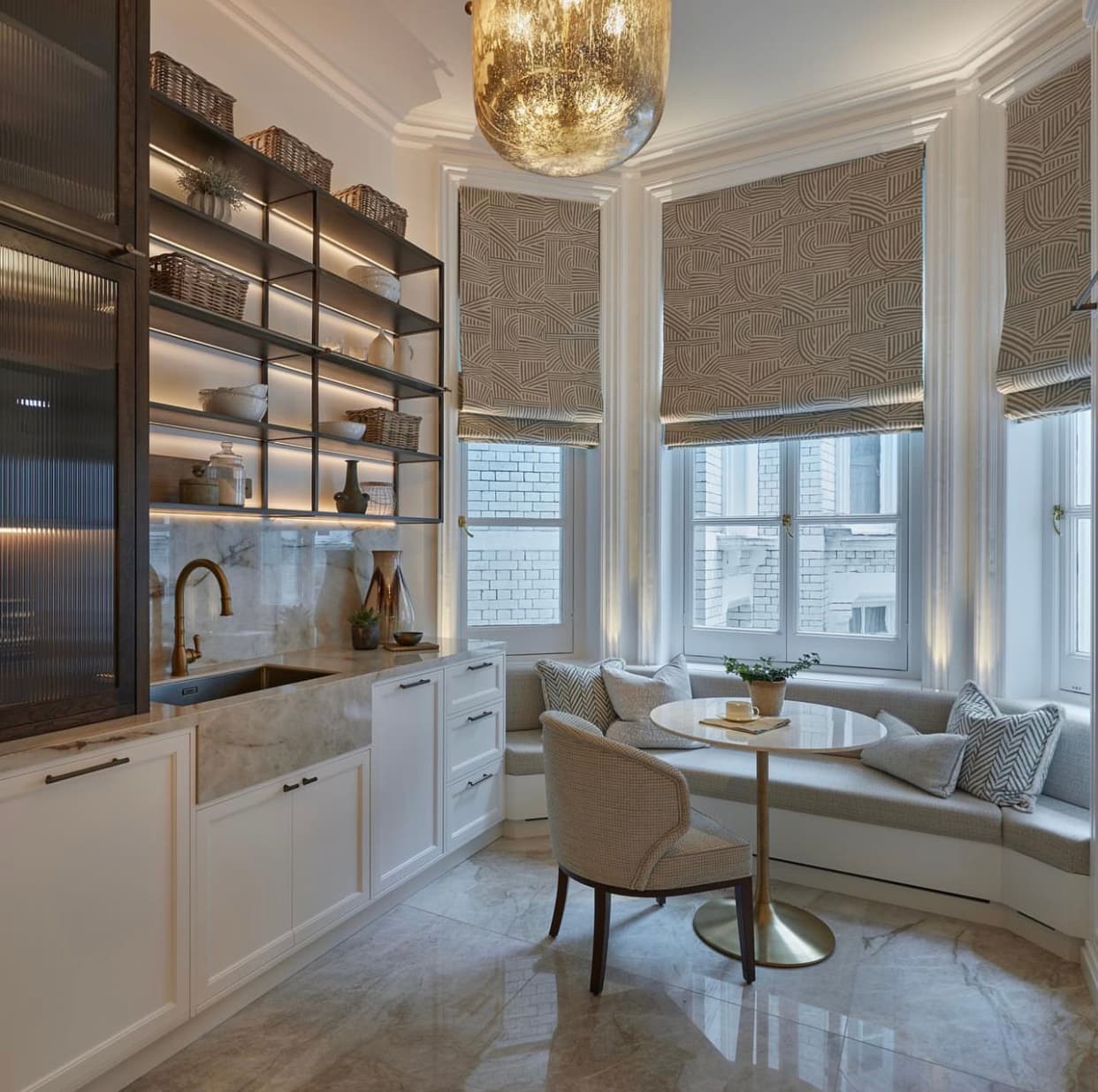
Banquette Seating Kitchen: The Art of Built-In Dining Done Properly
Explore how banquette seating transforms kitchen dining — from L-shaped corners and curved booths to storage-smart benches, upholstery choices, and dimensions that actually work. Inspiration for bespoke kitchens that invite you to sit down and stay.
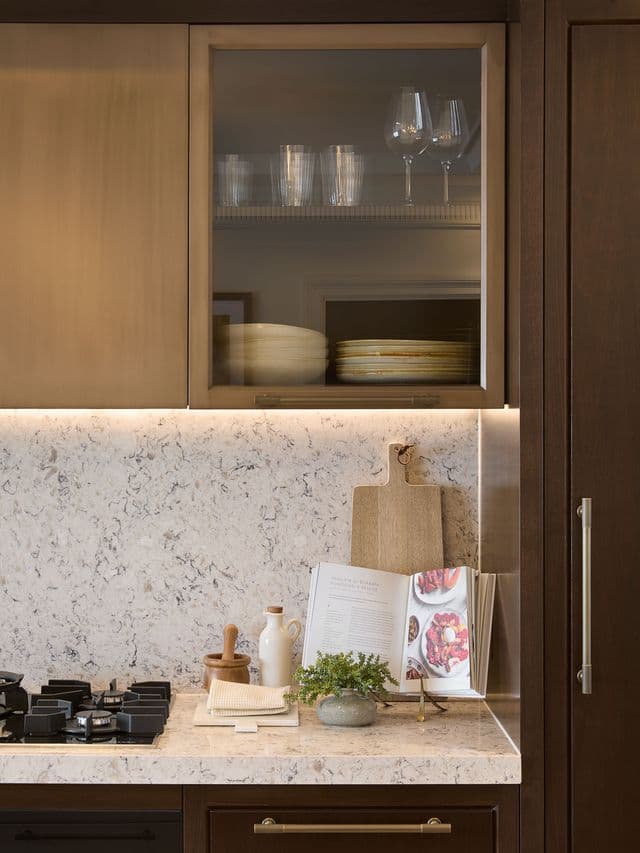
Arts and Crafts Kitchen Design: Where Handcraft Meets the Heart of the Home
Explore how the Arts and Crafts movement inspires truly bespoke kitchen design — from hand-forged ironmongery and English oak to William Morris colour palettes. A guide to creating kitchens that honour the handmade.
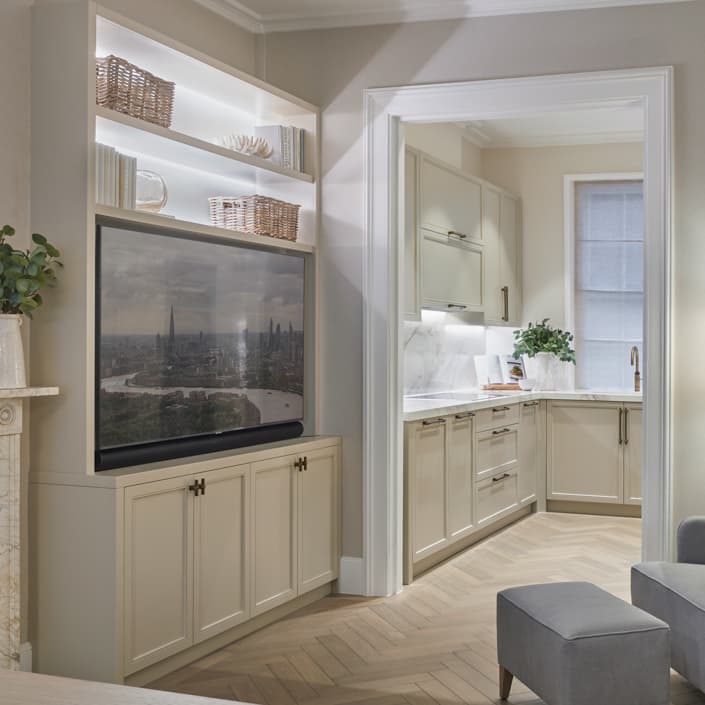
Barn Conversion Kitchen Design: Bespoke Kitchens for Extraordinary Spaces
Designing a kitchen for a barn conversion demands a bespoke approach. From double-height ceilings and exposed trusses to acoustic management and island design, discover how Albury House Kitchens creates luxury kitchens that honour agricultural architecture whilst delivering modern performance.