

Georgian Kitchen Design: Honouring Classical Architecture with Bespoke Craftsmanship
A considered guide to Georgian kitchen design — from symmetry and proportion to colour palettes, materials, and cabinetry that truly belong in a Georgian home. By Albury House Kitchens.
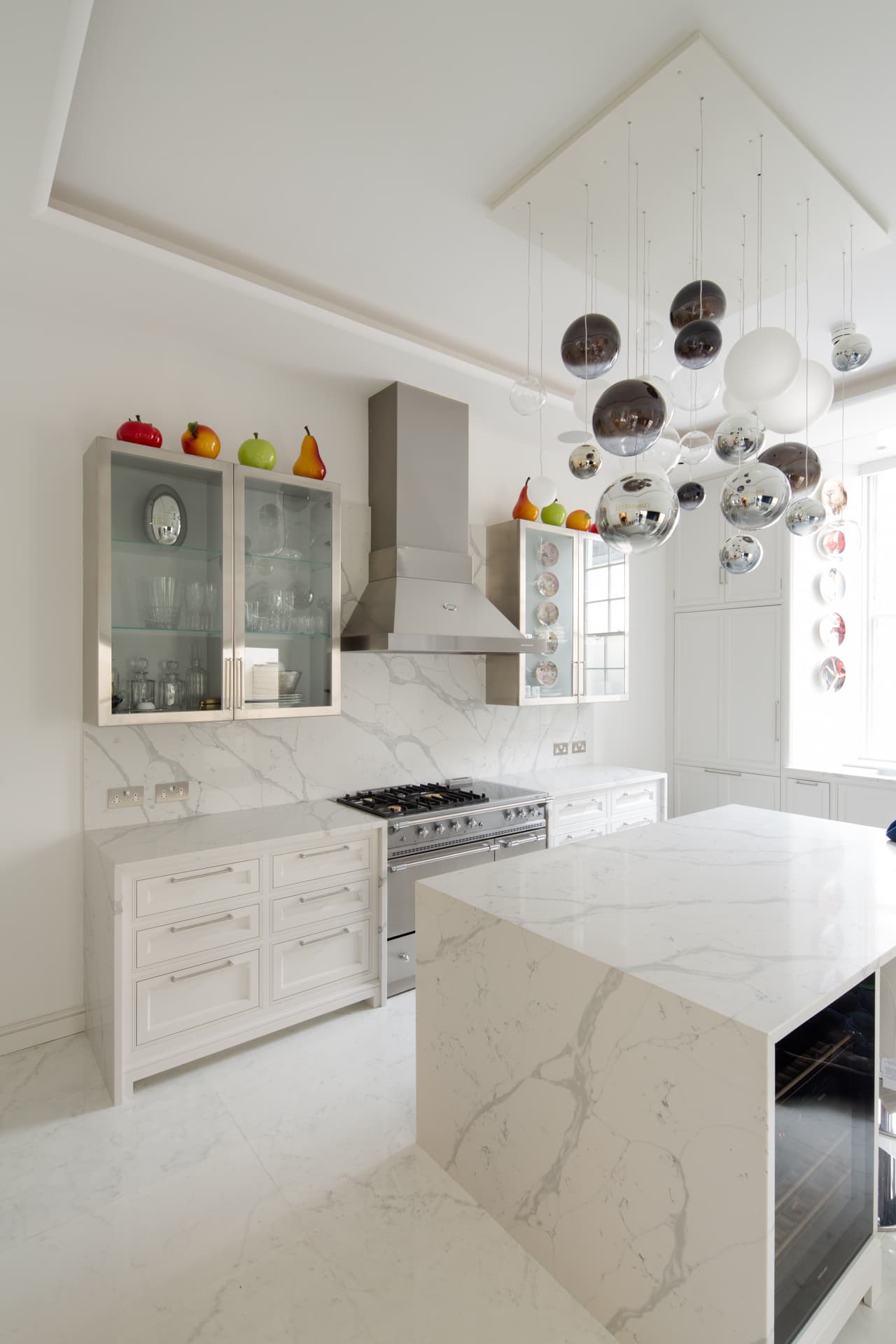
There is something deeply satisfying about a Georgian house. The proportions feel right before you can explain why. The windows are where they ought to be. The rooms proceed with a logic that is entirely deliberate and yet never feels forced. It is architecture governed by rules — classical rules, derived from ancient precedent — and the result, at its best, is a calm that very few other periods achieve.
Designing a kitchen for a Georgian home, then, is not simply a matter of choosing the right door style and hoping for the best. It asks you to understand what makes the house work — its rhythms, its visual grammar, its quiet insistence on order — and to carry those principles into a room that the original architects never quite imagined in its modern form.
At Albury House Kitchens, this is work we relish. We have designed and built bespoke kitchens for Georgian properties across Cambridge, Hampstead, and the wider Home Counties, and each project begins with the same fundamental question: how do we create something that feels as though it has always belonged here?
The Principles Behind the Architecture
Georgian architecture — spanning roughly from 1714 to 1830, and encompassing the Regency period that followed — draws its visual language from classical antiquity. The architects of the period studied Palladio, absorbed the proportional systems of ancient Rome, and applied them with remarkable discipline to the English townhouse, the country estate, and everything in between.
Three principles underpin almost every Georgian building, and they are worth understanding before you pick up a paint chart.
Symmetry
Georgian facades are symmetrical by instinct. The front door sits centrally, flanked by an equal number of windows on each side. This symmetry typically extends through the interior, with rooms arranged in balanced pairs around a central hallway or staircase. A kitchen designed for a Georgian home should echo this sense of balance — not slavishly, but with an awareness that the eye expects order. A run of cabinetry that terminates abruptly, or an island placed off-centre without purpose, will feel subtly wrong in a way it might not in a Victorian or contemporary space.
Proportion
The Georgians were fastidious about proportion. Room heights, window dimensions, and the relationship between walls and openings were all governed by mathematical ratios — often derived from the classical orders. Ceiling heights in principal rooms were generous; in service rooms and basements, they were more modest but still carefully considered. A Georgian kitchen design must respect these proportions. Tall wall units that crowd a lower-ground ceiling, or base cabinets that feel squat beneath a generous sash window, will undermine the architectural harmony that makes the house feel so effortlessly right.
Classical Order
Beyond symmetry and proportion, Georgian interiors employ a vocabulary of classical detail — cornicing, dado rails, architraves, pilasters, and panelling — that gives each room its structure and finish. These elements are not decorative afterthoughts; they are the grammar of the space. A kitchen that ignores them, or introduces a contradictory design language, will always feel like a foreign object within the house.
The most successful Georgian kitchen designs do not merely avoid clashing with these details — they continue them. The cabinetry becomes an extension of the architectural joinery, using the same profiles, the same proportional logic, and the same material sensibility as the rooms above.
Translating Georgian Principles into Kitchen Design
Understanding the theory is one thing. Applying it to a working kitchen — a room that must accommodate sinks, ovens, dishwashers, and the full chaos of family life — is quite another. This is where the distinction between bespoke design and off-the-shelf selection becomes most apparent.
A bespoke kitchen allows you to work within the precise proportions of your Georgian room rather than forcing standardised units into a space they were never designed for. Every dimension can be adjusted — the height of a cornice, the depth of a drawer, the width of a panel — so that the finished kitchen reads as architectural joinery rather than fitted furniture.
This matters enormously in Georgian houses, where the proportional relationships are so finely tuned that even small deviations register. A plinth that is ten millimetres too tall, or a cornice profile that doesn't relate to the existing architraves, will nag at the eye in a house where everything else is so carefully resolved.
If you are considering a kitchen for a period property, this sensitivity to proportion is not a luxury — it is the difference between a kitchen that sits comfortably in its setting and one that merely occupies space.
Cabinetry: The Heart of a Georgian Kitchen
In-Frame Construction
For Georgian properties, in-frame cabinetry is almost always the right starting point. The doors and drawers sit within a visible frame — much like the panelled doors found throughout a Georgian house — creating a robust, structured appearance that speaks the same visual language as the architecture.
This is not merely an aesthetic preference. In-frame construction is the traditional method of English cabinet-making, and it produces furniture of genuine structural integrity. The frame provides rigidity; the panels within it are free to move with seasonal changes in humidity. It is the way kitchen furniture was made when these houses were built, and it remains the finest way to make it now.
Panel Styles
Within the in-frame format, the choice of panel style sets the tone for the entire kitchen.
Raised-and-fielded panels are the most classically Georgian option. The central panel is raised with a bevelled edge, creating a subtle play of light and shadow that gives depth and formality to the cabinetry. This style works beautifully in reception-floor kitchens and larger Georgian rooms where a degree of grandeur is appropriate.
Flat panels with applied mouldings offer a slightly simpler, more restrained alternative. The panel sits flush within the frame, with a moulding applied around its perimeter. This approach suits Georgian houses of more modest proportions — the smaller townhouse, the mews cottage, the lower-ground kitchen where a lighter touch is welcome.
Beaded-edge panels provide an elegant middle ground. A delicate bead runs around the inside of the frame, adding definition without the visual weight of a raised panel. This is a particularly versatile option and one we use frequently in Georgian kitchen projects where the client wants something that feels period-appropriate without being overtly formal.
Classical Mouldings and Detail
The crowning detail of Georgian cabinetry — quite literally — is the cornice. A well-proportioned cornice at the top of tall cabinets or a dresser unit ties the kitchen into the architectural language of the house, particularly where there is existing cornicing in the room. We design bespoke cornice profiles for each project, often referencing the mouldings already present in the property to create a seamless visual connection.
Pilasters, plinth blocks, and corbels can also be employed to give cabinetry a more architectural presence, particularly in larger kitchens where the furniture needs to hold its own against generous room proportions. The key, as with all things Georgian, is restraint. Each detail should earn its place.
Colour: The Georgian Palette
The Georgians were not the restrained minimalists that popular imagination sometimes suggests. Their interiors were often richly coloured, particularly in the later Regency period. However, the colours they favoured have a particular quality — a chalkiness, a softness, a sense of having been in the room for a very long time — that distinguishes them from modern paint colours.
This is where heritage paint ranges come into their own. Farrow & Ball and Little Greene both offer palettes that are explicitly informed by Georgian and Regency interiors, and the depth of pigment in these paints produces a finish that flat-pack furniture with a vinyl wrap simply cannot replicate.
Greens
Soft, grey-tinged greens were enormously popular in Georgian interiors and translate beautifully to kitchen cabinetry. Colours such as Farrow & Ball's French Gray or Vert de Terre, or Little Greene's Aquamarine and Sage Green, evoke the restrained elegance of a Georgian drawing room without feeling museum-like.
Blues
Quiet, dusty blues — neither too bright nor too navy — sit comfortably in Georgian settings. Farrow & Ball's Lulworth Blue and Stone Blue, or Little Greene's Bone China Blue, offer that characteristic Georgian quality of colour that seems to shift gently with the light.
Whites and Off-Whites
A Georgian white is never a brilliant white. It is always warmed — by a touch of yellow, a whisper of grey, a barely-there pink. Pointing, Lime White, and Shaded White from Farrow & Ball, or Little Greene's Slaked Lime, are all excellent starting points for a kitchen where light and openness are priorities without sacrificing period warmth.
Greys
The mid-toned greys — Pavilion Gray, Lamp Room Gray, Hardwick White (which is, confusingly, a grey) — have become deservedly popular for Georgian kitchens. They provide a neutral foundation that allows natural materials to speak, and they sit effortlessly alongside original stone floors and marble surfaces.
We frequently use two or three tones within a single kitchen — a deeper colour on the island, a paler tone on the perimeter cabinetry, and a third for any dresser or larder unit — to create depth and visual interest whilst maintaining the overall sense of cohesion that Georgian architecture demands.
Materials: Substance and Authenticity
A Georgian house is built from materials of genuine substance — brick, stone, lime plaster, timber, iron — and the kitchen should continue that material honesty. This is not the place for laminate worktops or high-gloss acrylic, however technically competent they may be.
Worktops
Marble is the quintessentially Georgian surface. Carrara, Calacatta, and the softer-veined Bianco varieties bring a luminous quality to a kitchen that is entirely in keeping with the period. Marble does require a degree of care — it will patina over time — but many clients find this ageing process part of its appeal. A marble worktop in a Georgian kitchen acquires character in much the same way as the house itself.
Natural stone — including honed granite, quartzite, and indigenous limestones — offers greater durability for those who prefer a surface that needs less cosseting. A honed Portland limestone or a pale quartzite can provide the same tonal warmth as marble with considerably less anxiety.
Timber is historically appropriate and brings a warmth that stone alone cannot provide. We often use thick oak or iroko tops on island units, particularly where the island serves as the social heart of the kitchen, reserving stone for the perimeter runs where the heaviest preparation work takes place.
Cabinetry
Painted timber remains the material of choice for Georgian kitchen cabinetry. We build in tulipwood, birch ply, and solid hardwood frames, hand-finished with multiple coats of paint to produce the depth of colour and tactile quality that factory-applied finishes cannot match. The paint finish itself matters: an eggshell or soft sheen gives the chalky, slightly matte appearance that reads as authentically Georgian, whereas a high gloss would feel distinctly out of period.
Flooring
Where original flagstones survive, they should be celebrated. Where new flooring is required, natural stone flags, reclaimed brick paviours, or wide-plank timber boards are all historically sympathetic choices. The floor sets the foundational tone for the entire kitchen and should be considered early in the design process.
Hardware: The Finishing Grammar
Ironmongery may seem a minor consideration, but in a Georgian kitchen it performs the same role as punctuation in a sentence — it gives the composition its clarity and rhythm.
Brass
Unlacquered brass is the most historically appropriate choice for a Georgian kitchen. It arrives bright and golden, then gradually develops a warm, mottled patina that speaks of use and age. Polished brass offers a more formal, maintained appearance. Both are entirely appropriate; the choice is largely one of temperament.
Nickel
Polished nickel provides a cooler, more silvered alternative to brass — particularly well-suited to later Georgian and Regency interiors where the aesthetic was becoming lighter and more refined. Satin nickel offers the same tonal quality with a softer, less reflective finish.
Pull Handles and Knobs
Classical cup handles on drawers and round or oval knobs on doors are the most Georgian-appropriate choices. Elongated pull handles and D-handles can also work, provided they have a classical profile and are proportioned to suit the door or drawer they serve. As a general principle, the hardware should complement the cabinetry rather than draw attention to itself — a quiet punctuation mark, not an exclamation.
Working with Georgian Spaces
Georgian houses present particular spatial challenges that require experience and ingenuity to resolve well. Each project is different, but several themes recur across the listed buildings and period properties we work with.
Basement and Lower-Ground Kitchens
In Georgian townhouses, the kitchen was traditionally located in the basement — close to the coal store, the scullery, and the service entrance. Many contemporary kitchen projects in Georgian homes continue to use this lower-ground space, and the design challenges are significant.
Light is the foremost concern. Basement kitchens often rely on front or rear lightwells, and the quality of natural light can be limited. We address this through a combination of pale worktop materials (marble and light stone reflect available light beautifully), carefully positioned under-cabinet and in-cabinet lighting, and a considered colour palette that lifts the space without resorting to brilliant white.
Ceiling height requires sensitive handling. Lower-ground ceilings in Georgian townhouses are typically 2.2 to 2.5 metres — adequate, but not generous. Wall cabinetry must be proportioned to suit: too tall, and the room feels compressed; too short, and storage capacity is wasted. We draw every elevation to scale, testing proportions on paper before committing to manufacture, so that the cabinetry sits in proper relationship with the room.
Services — water, gas, electrical, ventilation — often follow historic routes through the basement level, and routing new services requires careful planning to avoid damage to the building fabric. This is particularly critical in listed buildings, where intrusive alterations may not receive consent.
Rear Extensions
Many Georgian homes have been extended at the rear over the centuries, sometimes sympathetically and sometimes less so. A well-designed rear extension can provide a generous kitchen and dining space that connects the house to its garden, and this is a brief we encounter frequently.
The key is to manage the transition between the original Georgian fabric and the new addition. We often design cabinetry that straddles this threshold — more traditional in character where it sits against the original walls, transitioning to something a little lighter and more contemporary where it faces the garden. This creates a sense of narrative within the room, acknowledging the house's evolution rather than pretending the extension has always been there.
Tall Sash Windows
Georgian sash windows are one of the period's great gifts — generous, beautifully proportioned, and capable of flooding a room with light. In a kitchen, however, they can present practical challenges. A run of cabinetry that blocks a sash window is an unforgivable sin in a Georgian house, so the kitchen layout must be designed around the window positions rather than in spite of them.
We frequently place sinks beneath sash windows — it is, after all, where most people would choose to stand — and design the surrounding cabinetry to frame the window rather than compete with it. In some cases, the windows themselves become a design feature, with open shelving or a glazed dresser unit arranged to echo their vertical proportions.
Modern Comforts, Georgian Manners
The art of Georgian kitchen design is not to recreate an eighteenth-century kitchen — nobody wants to cook over an open hearth — but to house twenty-first-century technology within a setting that feels true to the period.
This means concealing appliances wherever possible. Integrated refrigerators and freezers behind cabinetry panels, dishwashers hidden within the run of base units, and ovens housed within a classically proportioned surround all contribute to a kitchen that reads as furniture rather than equipment. The technology is there — induction hobs, steam ovens, boiling water taps, zoned underfloor heating — but it is absorbed into the design rather than displayed.
Extraction presents a particular challenge in Georgian kitchens, where a large stainless steel canopy would be violently out of character. Downdraft extractors, ceiling-mounted units, and discreetly ducted chimney-style hoods all offer solutions, and we advise on the most appropriate approach for each project.
Lighting, too, requires thought. Georgian rooms were lit by candles and, later, gas — sources that produce a warm, diffused light. A kitchen that relies solely on harsh overhead downlighters will never feel at home in a Georgian setting. We layer ambient, task, and accent lighting to create warmth and flexibility, often incorporating period-style pendants or wall lights alongside concealed LED sources.
From Cambridge to Hampstead: Georgian Kitchens in Practice
We have had the privilege of designing Georgian kitchens across a range of properties, and two projects in particular illustrate the breadth of the brief.
A Cambridge College Town Terrace
A four-storey Georgian townhouse near Cambridge's centre presented a classic lower-ground kitchen challenge — limited light, a linear floor plan, and original stone flags that the owners rightly wished to retain. We designed a run of in-frame cabinetry in a warm pale grey, with honed Carrara marble worktops and unlacquered brass hardware, keeping the palette deliberately light to reflect the available natural light from a front lightwell. A tall dresser unit at the far end of the room, painted in a slightly deeper tone, provided visual punctuation and additional storage. The result was a kitchen that felt quietly Georgian — ordered, proportionate, and entirely at ease in its setting.
A Hampstead Heath Townhouse
A substantial five-bedroom Georgian property near Hampstead Heath had undergone a sensitive rear extension, creating a generous kitchen and dining space that opened onto the garden. Here, the brief was more expansive — a large island with marble top, a bank of tall integrated appliances concealed behind panelled doors, and a butler's pantry beyond the main kitchen for additional preparation and storage. The cabinetry was painted in a soft heritage green — a colour drawn from the original shutters in the reception rooms — with polished nickel hardware and a reclaimed York stone floor. The extension's contemporary glazing was balanced by the traditionally detailed cabinetry, creating a room that felt both of its time and entirely respectful of the house's Georgian origins.
Beginning the Conversation
Designing a kitchen for a Georgian home is a collaborative process that begins with the house itself. Before we discuss door styles or worktop materials, we spend time understanding the building — its age, its proportions, its quirks, its character — because these are the things that should shape every design decision that follows.
If you own a Georgian property and are considering a new kitchen, we would welcome the opportunity to visit and discuss what might be possible. Our initial consultation is free, entirely without obligation, and best conducted in your own home, where the architecture can speak for itself.
Get in touch to arrange a home visit, or explore more of our thinking on period property kitchen design and kitchens for listed buildings.
Frequently Asked Questions
Thinking about a new kitchen?
Book Your Free ConsultationYou might also enjoy
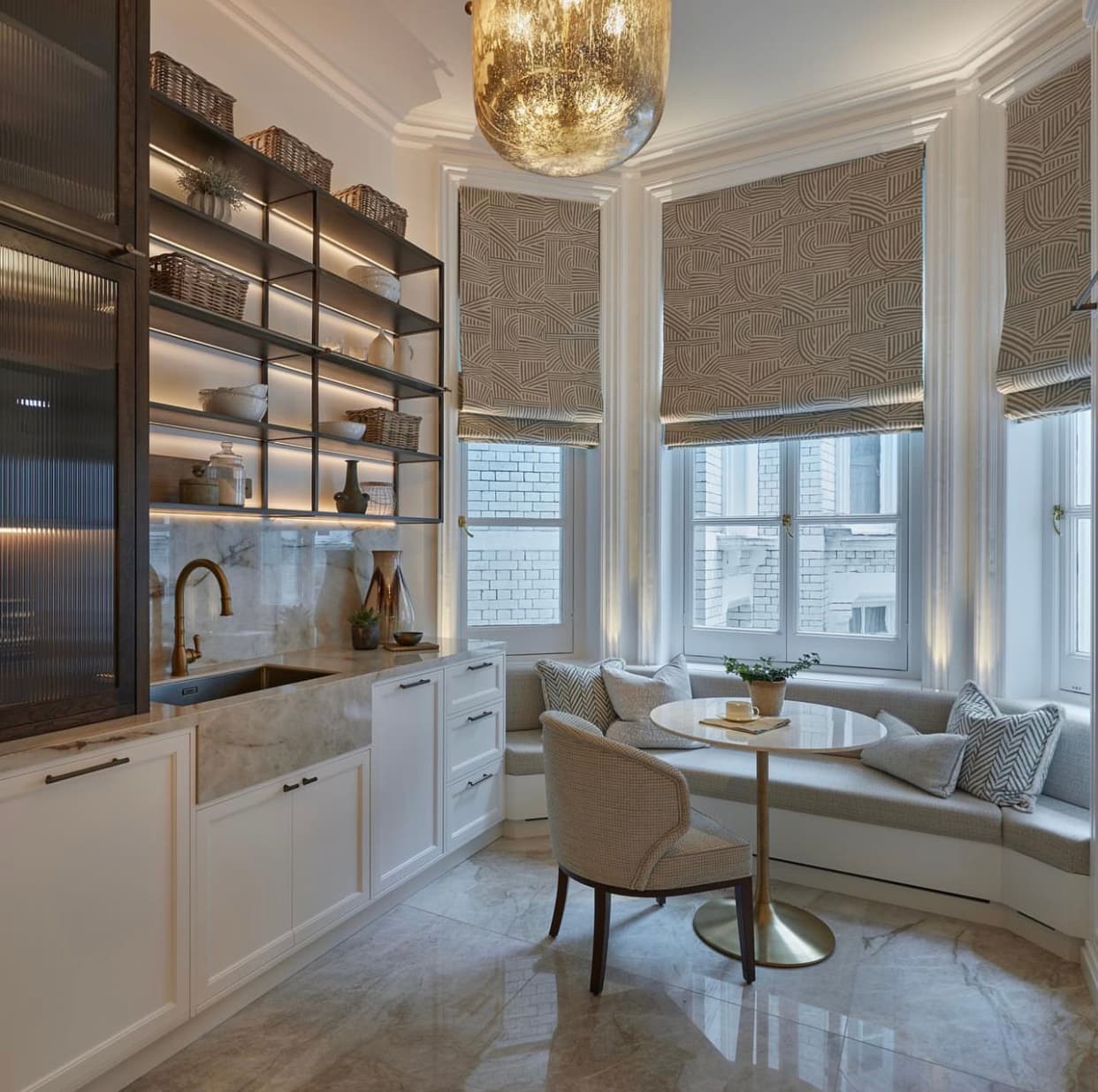
Banquette Seating Kitchen: The Art of Built-In Dining Done Properly
Explore how banquette seating transforms kitchen dining — from L-shaped corners and curved booths to storage-smart benches, upholstery choices, and dimensions that actually work. Inspiration for bespoke kitchens that invite you to sit down and stay.
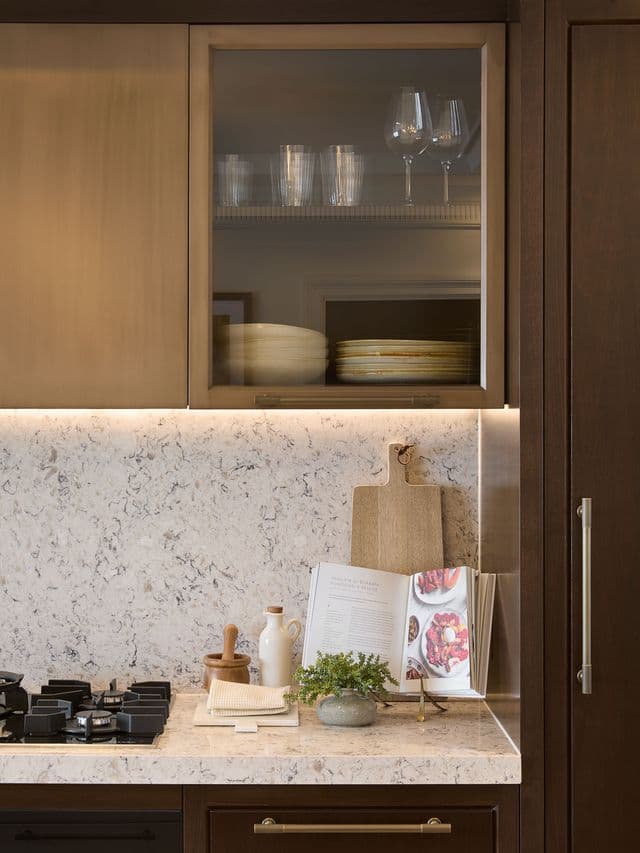
Arts and Crafts Kitchen Design: Where Handcraft Meets the Heart of the Home
Explore how the Arts and Crafts movement inspires truly bespoke kitchen design — from hand-forged ironmongery and English oak to William Morris colour palettes. A guide to creating kitchens that honour the handmade.
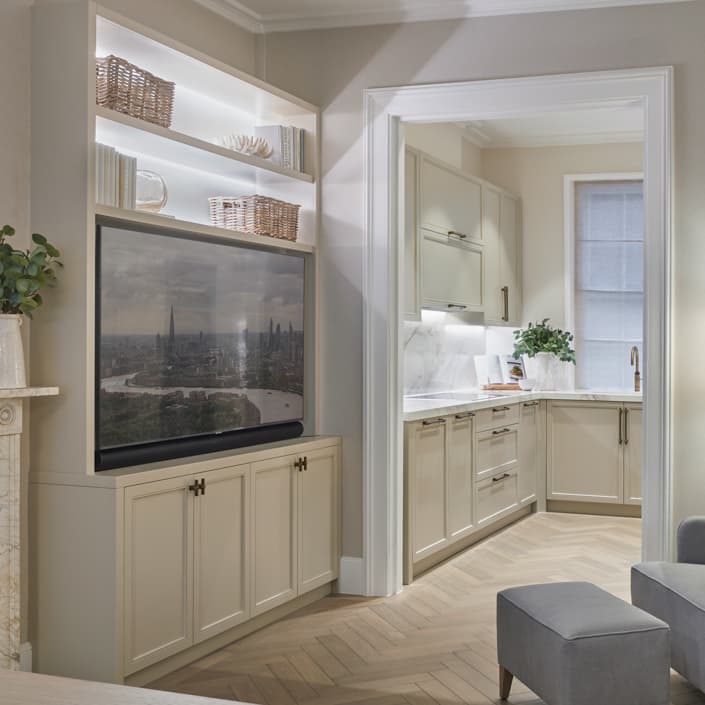
Barn Conversion Kitchen Design: Bespoke Kitchens for Extraordinary Spaces
Designing a kitchen for a barn conversion demands a bespoke approach. From double-height ceilings and exposed trusses to acoustic management and island design, discover how Albury House Kitchens creates luxury kitchens that honour agricultural architecture whilst delivering modern performance.